Changing the Narrative of Edgecomb Maine
“The roots of education are bitter, but the fruit is sweet”
Welcome to Edgecomb Learns, your local hub for understanding the challenges facing our schools and the community at large. From rising costs and state funding formulas to the complexities of shared administrative structures like AOS 98, education in Maine can be confusing — especially in small towns like ours. This site is here to help residents learn how the schools budget is set, how tax dollars are used, and why these decisions matter for the quality of education in Edgecomb. This site will also stage larger town issues in the context of the school to provide additional insight on impact. The goal is to provide resources and context in an increasingly complex educational landscape with some opinions about how to frame the narrative.
Edgecomb School Funding Explained
The following videos were put together by Heather Sinclair, School Board Chair in Edgecomb
Recent Articles

What does the Edgecomb of tomorrow look like for you? It’s a simple question on the surface, but one that asks each of us to consider not just what we value about this place today, but what we are willing to shape, support, and build together in the years ahead. Edgecomb has always been defined by its quiet strengths, its landscape, its people, its sense of place, but the future will not simply arrive on its own. It will be the result of choices, priorities, and a shared vision that balances preservation with progress.
Edgecomb is at an inflection point. Over the past two years, our town has witnessed an extraordinary surge in civic participation, most recently seen in the school budget annual meeting and the referendum vote that followed. The turnout has been nothing short of remarkable, signaling a clear shift from the days when Edgecomb was described, even in its own comprehensive plan, as a “pass-through town” on the way to Boothbay or Damariscotta. That label no longer fits.
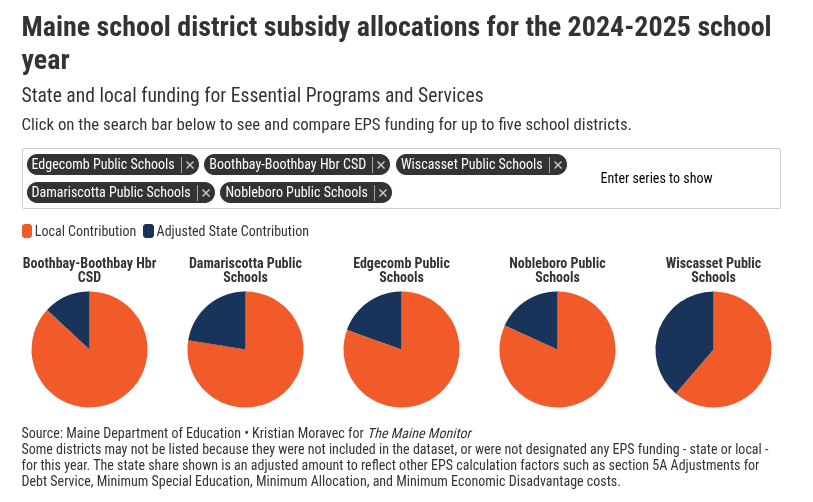
Public education in the United States is funded through a layered system that blends local, state, and federal dollars, but the balance of those sources varies dramatically by state and those differences shape everything from tax bills to classroom opportunity. Nationally, the federal government contributes only a small share distributed through state and federal programs, roughly 8–13%, with the rest split between state and local governments. What makes Maine distinct, particularly for small towns along the Midcoast, is just how heavily the system leans on local property taxes, and the consequences that follow from that reliance.
Having just wrapped up a budget cycle for the 2026-27 school year, I’m already looking ahead to the next budget cycle in 2027-28. Both locally in Edgecomb and across the broader education landscape, there are several clear pressures and decision points that will shape how school systems plan, prioritize, and ultimately allocate resources. While every community has its own dynamics, the same underlying forces (labor costs, healthcare inflation, facility needs, and contractual cycles) are converging in ways that will make the coming year especially important for thoughtful long-range planning.
Nearly a year ago, I was elected to the Edgecomb School Board with a sense of responsibility that I understood intellectually but did not yet fully grasp in practice. Over the course of the past year, that understanding has deepened in ways I did not anticipate. It has been a year of learning, listening, and at times, difficult reflection about our town, our school, and the broader pressures shaping both. What I have come to appreciate most is that Edgecomb is not static, it is a living community shaped by competing needs, limited resources, and a shared desire to do right by our children and our neighbors.
When people in Edgecomb talk about tuition students, the conversation often drifts into assumptions, quick conclusions, or incomplete information for both those believing tuition students bring a windfall and those that believe that they cost the town significantly. But if we’re going to make thoughtful decisions as a community, we need to look clearly at both the financial realities and the educational impact. This isn’t just about numbers on a spreadsheet, it’s about how we structure our classrooms, support our teachers, and shape the experience of every student who walks through the doors of Edgecomb Eddy School.
A closer look at the Edgecomb Eddy budget—particularly the attached spreadsheet that strips out special education costs, tuition payments to other districts for secondary students, and associated transportation—reveals a focused estimate of what it costs to educate a “regular education” student: approximately $22,626 per pupil. It’s important to note, however, that there is no single universally accepted way to calculate “cost per student.” Different methodologies can yield very different figures depending on what is included or excluded. Some approaches calculate total district spending divided by all enrolled students, fully loading in special education, debt service, transportation, and administrative overhead. Others allocate costs by program (for example, separating elementary vs. secondary or general vs. special education), or even attempt to assign school-level costs based on staffing ratios and facility usage. This analysis takes a more targeted approach by base lining to core instruction and essential operating expenses tied directly to general education, providing a clearer view of the cost structure for the majority of students at Edgecomb Eddy.
School testing in Maine is designed to provide a consistent, statewide snapshot of student learning, but understanding what those results actually mean, especially in a small town like Edgecomb, requires context, nuance, and a broader view of school performance. Through the Maine Comprehensive Assessment System (MECAS), students in grades 3–8 participate in the Maine Through Year Assessment in reading and math, administered in multiple windows throughout the school year (fall, winter, and spring), while science is assessed in grades 5, 8, and once in high school. These tests are typically computer-based and designed to measure not just rote knowledge, but applied skills and problem-solving. They are administered locally by classroom teachers and trained staff, but aligned to state and federal accountability requirements. Importantly, Maine’s own Department of Education consistently emphasizes that these results should not be viewed in isolation, they are just one data point among many and should be considered alongside classroom performance, teacher insight, and student growth over time.
Across the Midcoast , it’s common to hear people question why public elementary schools appear to spend far more per student than private schools charge in tuition. At first glance, the comparison seems straightforward, public school costs per pupil can approach or exceed $20,000 annually, while private elementary tuition is often significantly lower. But this apparent gap is less about inefficiency and more about what each number actually represents. Public school “cost per student” reflects the total cost of operating an entire educational system divided by enrollment, not the marginal cost of educating one additional child. That figure includes everything from maintaining school buildings and running transportation systems to providing technology, administration, and a wide range of student services that are largely invisible in a tuition bill.
In small, rural schools like Edgecomb Eddy, enrollment isn’t just a number, it is the foundation of the entire financial model. Using the Maine Department of Education’s FY 2025–26 ED279 report for Edgecomb, we can clearly see that even the loss of a single student has a measurable and meaningful impact on the school’s finances. And more importantly, it highlights a fundamental challenge: when a student leaves, the funding goes with them, but the associated real costs do not.
Contact Us
Please reach out if you have questions or comments